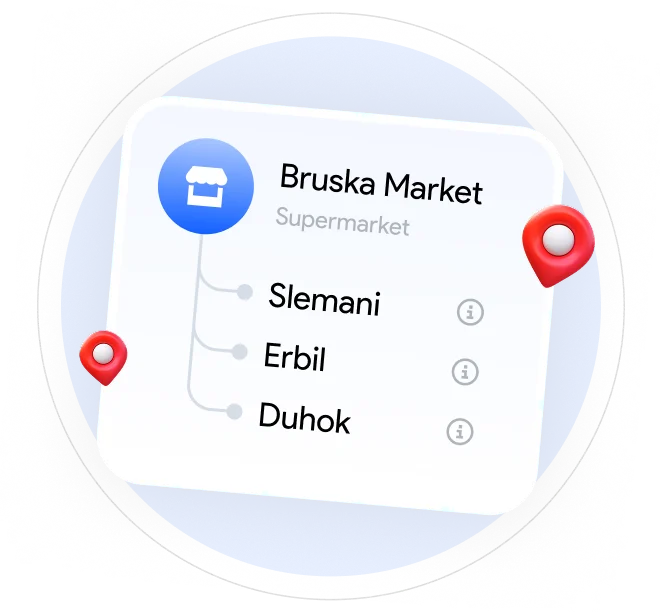
Managing inventory in one warehouse is already challenging.
Managing it across multiple warehouses is where many businesses lose control.
Without proper tracking, businesses face stock mismatches, delayed deliveries, overstock in one location, shortages in another, and lost sales opportunities.
In this guide, we show you how to track stock across multiple warehouses effectively and how to turn that capability into a competitive advantage.
Key takeaways
- Multi-warehouse inventory only works well when all locations are connected through one system.
- Real-time updates, transfer control, and location-based visibility are essential for accurate stock management.
- The right system turns multi-warehouse complexity into better speed, distribution, and decision-making.
Why multi-warehouse tracking matters
As businesses grow, they often add multiple storage locations, distribution centers, or stock points across different cities and zones. If those locations are not connected, teams lose visibility and coordination quickly.
Multi-warehouse tracking gives the business full control over inventory everywhere instead of treating each location like a separate blind spot.
Common problems businesses face
Many companies struggle because each warehouse operates separately, there is no real-time stock visibility, records are duplicated or missing, and communication between teams is weak.
When businesses rely on Excel, paper, or disconnected updates, those issues almost always lead to financial loss and customer dissatisfaction.
1. Centralize all inventory data
A common mistake is letting each warehouse track stock independently. That creates multiple versions of the truth and makes management reporting unreliable.
The fix is to use one centralized system that connects all warehouses into a single platform. That way, leadership and teams can see stock across all locations from one dashboard.
- Use one centralized inventory system.
- Connect all warehouse locations in the same platform.
- Maintain one source of truth for stock data.
2. Track stock by location
Inventory visibility is not only about knowing what stock exists. It is also about knowing where that stock is.
Businesses should be able to see quantity per warehouse, available versus reserved stock, and incoming and outgoing stock by location.
- Track quantity per warehouse.
- Separate available stock from reserved stock.
- Monitor incoming and outgoing stock by location.
3. Enable real-time updates
Updating stock only at the end of the day creates outdated information. By the time teams see the numbers, they may already be wrong.
Real-time updates after every transaction help sales, purchasing, and warehouse teams make better decisions with accurate data.
- Update stock immediately after each transaction.
- Sync inventory across warehouses in real time.
- Reduce delays between warehouse activity and system visibility.
4. Manage stock transfers between warehouses
Stock does not remain still. It moves between locations based on demand, replenishment needs, and operational priorities. If those transfers are handled manually or not tracked properly, missing inventory and confusion become common.
Every transfer should be requested, approved, tracked, and completed inside the system.
- Track transfer requests.
- Use a clear approval process when needed.
- Monitor transfer status until completion.
5. Use standardized processes across warehouses
When each warehouse follows different rules for receiving, storage, and dispatch, inconsistency grows and training becomes harder.
Standardized processes improve efficiency and make performance more predictable across all locations.
- Standardize receiving processes.
- Standardize storage and dispatch rules.
- Train all warehouse teams on the same workflow.
6. Track batch, expiry, and product variants
This is especially important in FMCG businesses. It is not enough to know total quantity if you do not know which batch it belongs to, when it expires, or which product variant it is.
Tracking these details reduces waste and improves stock rotation quality.
- Track products by batch.
- Monitor expiry dates actively.
- Handle product variants such as size or packaging properly.
7. Give teams the right tools
Warehouse operations do not happen behind a desk. Teams need practical tools that work in the real environment of receiving, picking, moving, and dispatching stock.
Mobile or tablet access, barcode scanning where relevant, and simple interfaces all improve speed and accuracy.
8. Connect inventory with sales and distribution
This is where many systems fail. Sales teams should know stock availability in real time, know which warehouse has what, and plan customer orders and deliveries accordingly.
Inventory should support sales and distribution instead of blocking them.
- Give sales teams live stock visibility.
- Show which warehouse holds each product.
- Connect inventory availability with delivery planning.
9. Monitor stock movement and performance
Inventory control becomes more useful when the business studies how stock actually behaves. That includes tracking fast-moving versus slow-moving items, stock levels per location, transfer frequency, and warehouse efficiency.
This data helps management optimize both stock allocation and operational performance.
10. Identify gaps across locations
The real value of multi-warehouse tracking is not only visibility. It is insight. A strong system should show which warehouse is overstocked, which one is understocked, and which cities or zones have weak product availability.
That insight helps balance inventory better and improve sales performance across the network.
Manual versus automated multi-warehouse tracking
Manual tracking through Excel or paper carries high error risk, no real-time updates, poor coordination, and low scalability. As warehouse complexity grows, those weaknesses become more costly.
An automated ERP-based system gives businesses real-time visibility, centralized control, and more accurate tracking across all locations. For companies planning to grow, automation is not a luxury. It is a requirement.
How Bruska helps businesses manage multiple warehouses
With Bruska ERP, businesses can track stock across warehouses in real time, manage transfers between locations, monitor batches and expiry, equip warehouse teams with dedicated mobile tools, and connect inventory with sales, delivery, and accounting.
That creates better operational control across cities, zones, and distribution channels while reducing the confusion that comes from disconnected warehouse systems.
Conclusion
Managing multiple warehouses without a proper system is like running multiple businesses blindly. But when it is done well, it becomes a real operational advantage. Businesses deliver faster, distribute stock better, satisfy customers more consistently, and support more sales growth.
The difference is not the number of warehouses. It is the quality of the system connecting them.
 Bruska ERP
Take control of all your warehouses
Book a demo with Bruska ERP and see how your business can manage stock, transfers, expiry, and distribution across multiple warehouses in one connected system.
more than 1,000 companies trust us













































More from Bruska
Continue reading

Inventory
Inventory Management Mistakes That Cost Businesses Thousands
Inventory mistakes quietly damage profits through waste, stockouts, and bad decisions. This guide explains the most common inventory management mistakes and how to fix them.
Read article
Inventory
What is Inventory Turnover and Why It Matters
Inventory turnover shows how quickly your business sells and replaces stock. This guide explains how to calculate it, why it matters, and how to improve it.
Read article
Inventory
How to Prevent Stock Loss and Theft
Learn how businesses can prevent stock loss and theft with better inventory tracking, stronger controls, and more accountability.
Read article