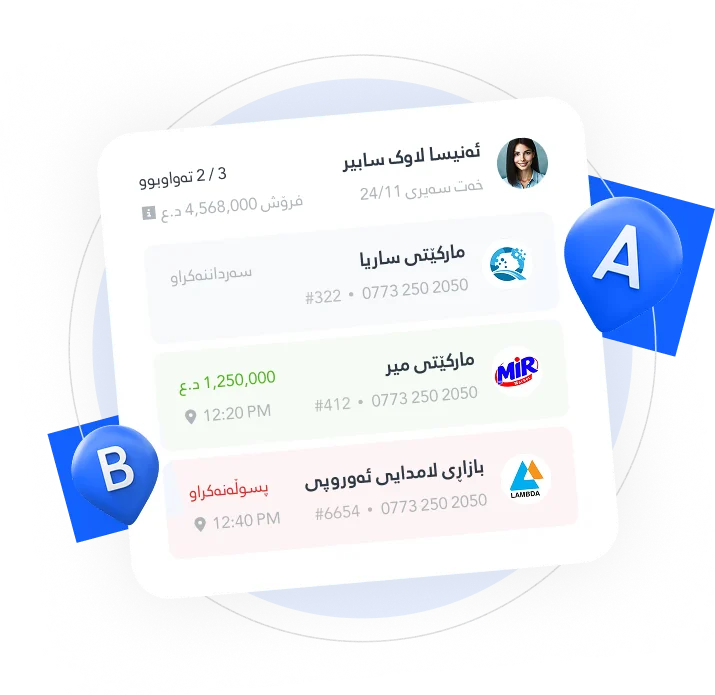
If your sales team is not hitting targets, the problem is usually not the people.
It is the system.
Most businesses assume they need better salespeople, that the market is slow, or that customers are not buying. But in reality, underperformance often comes from lack of structure, lack of visibility, and lack of accountability.
In this article, we break down why sales teams underperform and how to fix it using a smarter, CRM-driven approach.
Key takeaways
- Sales underperformance usually comes from broken structure, weak visibility, and unclear accountability.
- Visit planning, target setting, and real-time CRM tracking make sales operations more consistent and measurable.
- The fastest way to improve sales is often to fix the system around the team, not just pressure the team harder.
The real reason sales teams underperform
Before fixing anything, it helps to reframe the problem. Sales teams usually do not fail because they refuse to work hard. They fail because they do not know exactly what to do, when to do it, and how well they are doing it.
When the operating system around the team is weak, even good people produce inconsistent results. That is why improving sales performance often begins with improving the process.
1. No clear daily structure
A common problem is that sales agents start the day without a clear plan. There are no defined customer visits, no route planning, and no real priority list.
The result is wasted time, missed opportunities, and uneven performance. Some customers get too much attention while others get ignored completely.
- Give every sales agent a daily visit schedule.
- Assign customer lists clearly.
- Use optimized routes instead of random movement.
Implement visit plans to create consistency
A structured visit plan gives the team direction. It tells each agent which customers to visit, in what order, and with what frequency.
Structure creates consistency, and consistency is what turns activity into reliable sales results.
2. No visibility into field activities
Many managers do not actually know who visited which customer, what happened during visits, or how agents are spending their time in the field.
Without that visibility, there is no real accountability and no reliable basis for improvement.
- Track customer visits in real time.
- Monitor field activity with GPS visibility when needed.
- Log the outcome of every visit and interaction.
Use CRM tracking and GPS visibility
A CRM system helps teams capture activity as it happens. GPS visibility adds another layer of accountability for field operations, especially in distribution-heavy businesses.
What gets tracked gets improved. Visibility turns management from assumption into observation.
3. No comparison between plan and execution
Some companies do create plans, but no one checks whether those plans were followed. Planned visits and actual visits drift apart, and missed customers go unnoticed.
When there is no comparison between plan and execution, planning loses its value.
- Track completed visits.
- Track missed visits.
- Track extra or unplanned visits.
Track plan versus actual
The gap between plan and actual execution is one of the most useful performance signals in sales. It shows whether the team is following the system or quietly drifting away from it.
This is where real performance insight starts. Not just what was intended, but what really happened.
4. Weak or non-existent sales targets
When targets are vague, unrealistic, or not tracked properly, agents lose direction. They do not know what success looks like, and managers do not have a consistent way to measure progress.
Weak targets create weak accountability.
- Set monthly targets.
- Set quarterly targets.
- Define both individual and team goals.
Go beyond simple revenue targets
Revenue alone is not enough to understand sales performance. Businesses should also track number of orders, visit count, and conversion rates.
This gives a fuller performance picture and makes it easier to identify whether a problem is happening in activity, execution, or closing.
5. No quarterly sales strategy
Some sales teams operate only day to day, without a broader plan for growth. That leads to reactive behavior, weak market expansion, and little strategic momentum.
Quarterly planning creates a larger direction for the team, not just daily motion.
- Define revenue goals.
- Plan new customer acquisition.
- Set expansion goals for new cities or zones.
- Identify focus products and campaigns.
6. Ignoring market gaps
One of the biggest hidden reasons for weak sales performance is that businesses fail to study what is missing in the market. They do not ask which products are underperforming, which customers are unvisited, or which areas are under-covered.
Growth opportunities are often hidden in those gaps rather than in the most visible parts of current performance.
- Identify missing products and ignored SKUs.
- Find customers who are inactive or never visited.
- Spot weak cities, zones, and competitor-heavy areas.
Use data to identify gaps
A strong CRM should highlight missing products, missing customers, and missing geographic coverage. These are not minor details. They are growth signals.
Businesses improve faster when they understand not only what is happening, but what is not happening that should be.
7. Poor communication and feedback loops
Sales agents often work in isolation when managers do not provide regular feedback based on real data. In that environment, the same mistakes repeat and improvement slows down.
Good feedback loops help coaching become practical instead of vague.
Create data-driven feedback
The best feedback is based on facts, not opinions. Use real performance data to coach agents, identify weak areas, and refine strategy over time.
This makes management more constructive and helps salespeople improve with more clarity.
8. Relying on manual reporting
Excel sheets, end-of-day messages, and delayed reporting create inaccurate data and slow decisions. By the time management sees the problem, the team may have been off track for too long.
Manual reporting is too slow for modern sales operations, especially with field teams.
- Automate activity tracking.
- Monitor performance in real time.
- Generate reports instantly instead of waiting for manual summaries.
Signs your sales system is broken
If you do not know what agents did today, if targets are consistently missed, if some customers are never visited, if certain areas generate no sales, or if reports are delayed and unclear, then the problem is likely the system, not just the people.
The good news is that these problems are fixable once the business introduces the right structure.
How Bruska helps fix sales underperformance
With Bruska ERP’s CRM, businesses can create visit plans for field agents, track planned versus actual visits, monitor agents with GPS, set monthly and quarterly targets, identify missing customers and weak zones, and view real-time sales dashboards.
This gives teams the structure, visibility, and accountability needed to turn inconsistent sales operations into a more predictable performance engine.
Conclusion
Sales underperformance is rarely just about effort. It is usually about systems and visibility. When a business introduces structured visit plans, clear targets, real-time tracking, and data-driven decisions, sales performance becomes more predictable, scalable, and easier to improve.
The right response is not more pressure. It is better systems.
 Bruska ERP
Fix your sales performance with the right CRM
Book a demo with Bruska ERP and see how your business can manage field sales, targets, visits, and team performance with much more clarity.
more than 1,000 companies trust us













































More from Bruska
Continue reading

CRM
How to Track Sales Team Performance Effectively
Sales performance improves when teams are measured with structure and visibility. This guide explains how to track field sales activity, targets, visits, and market gaps effectively.
Read article
FMCG
Batch & Expiry Tracking for FMCG Businesses
Batch and expiry tracking helps FMCG businesses reduce waste, protect customer trust, and gain better control over stock movement and risk.
Read article
ERP
ERP Software for Iraqi FMCG Companies
Learn why Iraqi FMCG companies are adopting ERP software and what features matter most for distribution, inventory, finance, and field operations.
Read article